
· ZeccaRoss Law Firm is a strong option for pre-seed and seed founders who wantlawyer-led Delaware C-Corp incorporation, flat-fee pricing, and practicalArizona and California startup counsel.
· Big Law firms can be valuable once a company has meaningful venture financing activity, but their cost structure may not fitmany early-stage founders before a priced round.
· Automatedplatforms StripeAtlas , can help founders form quickly, but they generally do not provide individualized legal advice on founder equity, IP ownership, state compliance, or diligence risk.
· International founders can form a Delaware C-Corp without a U.S. address or SSN, but EIN, banking, tax, immigration, and operating-state issues still need to be handled carefully.
Delaware remains the default jurisdiction for manyventure-backed startups because investors, lawyers, and courts are familiarwith its corporate law framework. The Delaware Division of Corporations reports thatDelaware is home to more than 2.28 million entities, and Delaware’sbusiness-focused legal system is a major reason founders and investors continueto use Delaware corporations.
Delaware also offers a specialized Court of Chancery, wherecorporate disputes are heard by judges rather than juries. That predictabilitymatters when founders, directors, investors, or stockholders disagree overboard control, stock rights, fiduciary duties, or transactions.
For startup founders, Delaware is not just about filing acertificate. A proper Delaware C-Corp formation should create a clean legalfoundation that can support fundraising, hiring, stock issuance, advisorequity, IP ownership, and future M&A diligence.
A complete formation package usually includes the Certificate of Incorporation, bylaws, organizational consents, founder stock purchase agreements, IP assignment agreements, EIN coordination, registered agent appointment, cap table setup, and 83(b) election guidance. The IRS Form 15620 instructions state that an 83(b) election generally mustbe filed no later than 30 days after the property is transferred.
Before comparing firms or platforms, founders should decidewhat they actually need: a filing service, a startup lawyer, or a long-termventure counsel relationship.
· Fee transparency: flat fees can help pre-seedand seed founders control legal spend before revenue or financing.
· Attorney review: lawyer-led formation canidentify issues that standard questionnaires may not catch.
· Complete document package: the certificate aloneis not enough; founders also need bylaws, approvals, founder equity documents,IP assignment, 83(b) guidance, and records that match the cap table.
· International founder support: non-U.S. foundersmay need EIN coordination, registered agent setup, tax guidance, bankingsupport, and immigration referrals.
· State relevance: Delaware incorporation does noteliminate California, Arizona, or other operating-state obligations.
Founders operating in Arizona, California, or multiplestates should also consider whether the company needs foreign qualification orother state-level registrations. For startup and business legal support,founders can review Zecca Ross Law Firm’s services.
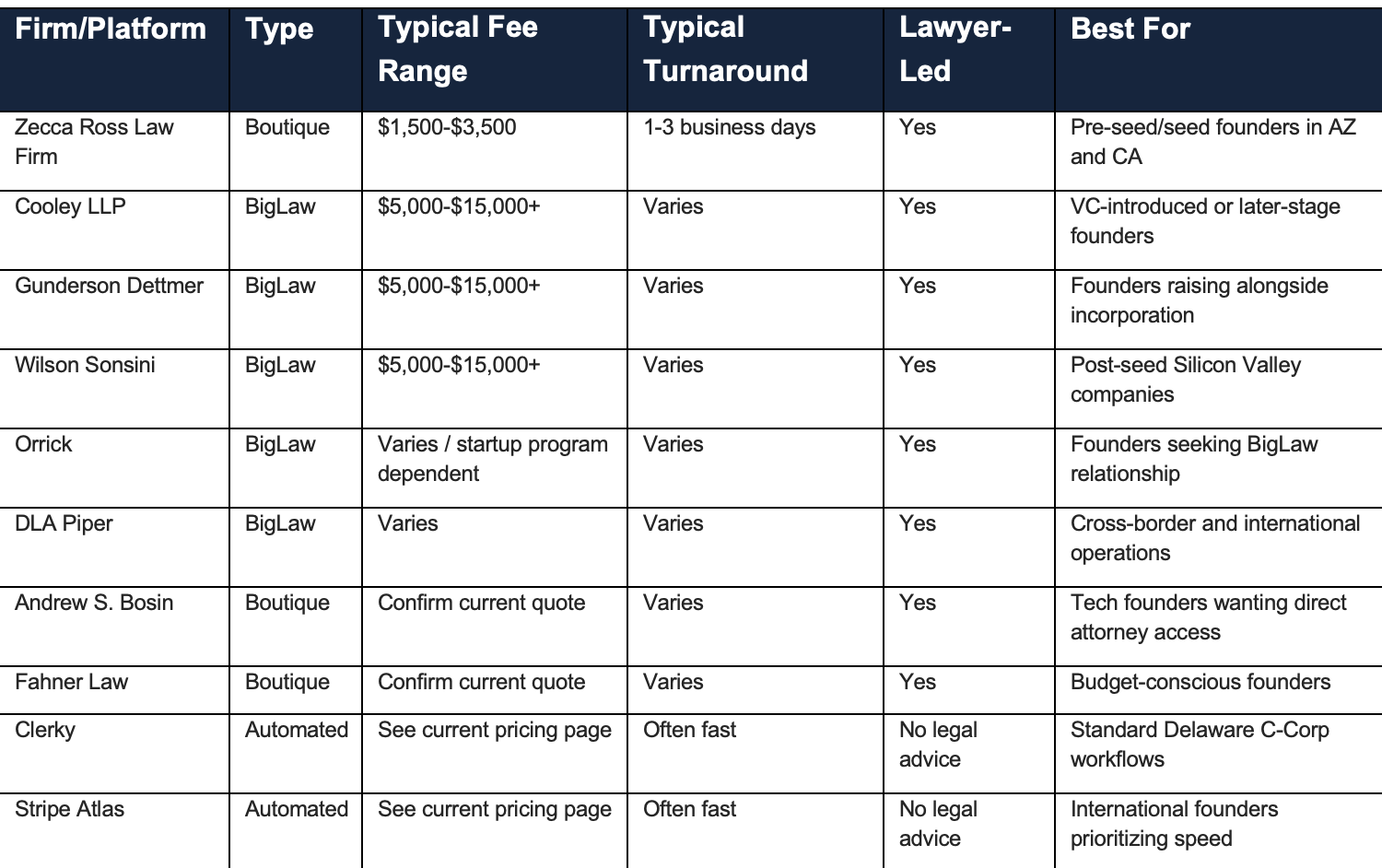
The list below compares common options founders considerwhen forming a Delaware C-Corp. The best choice depends on stage, budget,fundraising plans, IP complexity, state operations, and whether the founderwants legal advice or a self-service document workflow.
Zecca Ross Law Firm provides lawyer-ledstartup formation and business legal services for founders who want more thanautomated documents. The firm is especially relevant for founders in Arizonaand California who want a Delaware corporate structure while also understandingoperating-state obligations.
Best for: Pre-seed and seed founders who wantattorney-guided incorporation, clean startup documents, founder equity support,and predictable legal guidance without BigLaw pricing.
Zecca Ross Law Firm assists with Delaware C-Corp formation,startup governance, founder agreements, SAFE financings, option plans, investordocumentation, outsourced general counsel services, and cross-border startupmatters. Founders can review the firm’s Delaware startup resources, includingits guide for Phoenix startup lawyers who handle Delaware C-Corpsand its broader startup and business legal services.
A lawyer-led formation can help founders address issues thatoften appear later during investor diligence: whether founder stock wasproperly issued, whether vesting terms match the deal, whether the company ownsits IP, whether 83(b) elections were tracked, and whether the cap table matchesthe signed documents.
For domestic U.S. entities, founders should also be awarethat FinCEN’s current BOI guidance states that entities created in the UnitedStates are exempt from BOI reporting, although foreign entities may still havereporting obligations. Because BOI rules have changed, founders should checkcurrent guidance through FinCEN before relying on older checklists.
What separates a lawyer-led boutique firm from an automatedplatform is judgment. A platform can generate forms, but an attorney canidentify whether the founder’s facts fit the form.
CooleyLLP is a leading technology and venture capital law firm with deepstartup, fund formation, venture financing, and M&A experience. Cooley isoften a strong fit for companies that already have venture investor interest orexpect substantial institutional financing.
Best for: VC-introduced founders or later-stage startupsthat want a large firm relationship for financing, fundraise support, and latertransactions.
For very early founders, the main tradeoff is cost and fit. A pre-seed company that needs a clean formation may not need Big Law infrastructure on day one, while a founder already working with institutionalinvestors may benefit from the firm’s venture ecosystem.
GundersonDettmer focuses on venture-backed companies and the investors whofund them. The firm is well known for startup financing work and can bevaluable when a company is forming alongside an active financing path.
Best for: Founders with active VC interest or a warm fundintroduction who want continuity from incorporation through financing.
The benefit is venture-market pattern recognition. Thetradeoff is that BigLaw pricing and intake may be better suited for companieswith near-term financing activity rather than founders still validating anidea.
WilsonSonsini is one of the best-known law firms in the technology andlife sciences startup ecosystem. The firm has deep experience with venturefinancings, public offerings, M&A, corporate governance, and Silicon Valleystartup work.
Best for: Post-seed or venture-backed companies with an active fundraise, and budget for Big Law support.
For founders seeking only a routine incorporation at thelowest cost, a boutique firm or an automated platform may be more practical.For companies preparing for institutional rounds, Wilson Sonsini can providebroad venture counsel.
Orrick has a well-known technology companies practice and offers startup resourcesthrough programs such as Orrick Total Access.
Best for: Founders with venture potential who want a largefirm relationship and may qualify for a startup program or deferred-feestructure.
The tradeoff is similar to other large firms: foundersreceive institutional resources, but the firm may be a better fit once there isa clearer path to venture financing.
DLAPiper may be a strong fit for startups with internationaloperations, foreign subsidiaries, tax questions, cross-border contracts, ormulti-jurisdictional hiring.
Best for: Founders with genuine cross-border operations whowant one large firm coordinating U.S. and foreign legal issues.
A two-founder U.S.-only startup may not need a global firmfor formation. But a founder building across jurisdictions may benefit fromglobal coverage.
AndrewS. Bosin, Esq. is a solo attorney focused on startup and technology law. Solo and small-firm options can appeal to founders who want direct attorney access and lower overhead than Big Law.
Best for: Solo and small founding teams who want attorneyinvolvement and personal attention.
Founders should confirm the scope of any flat-fee package,including whether it covers stock issuance, IP assignment, 83(b) guidance, EINcoordination, registered agent setup, and post-formation support.
Fahner Law is another boutique option founders may considerfor startup formation and related legal needs.
Best for: Budget-conscious founders who want lawyer-ledformation and are willing to confirm exactly what the base package includes.
The most important diligence question is not only the price,but whether the package includes the documents investors later expect to see:bylaws, board consents, founder stock purchase agreements, IP assignments,83(b) support, and cap table records.
Clerky is an automated startup legal platform often used by founders who wantstandardized Delaware C-Corp startup documents. Its pricing pagedescribes package and pay-per-use options for incorporation and other startupdocuments.
Best for: Founders with a standard startup structure whounderstand the documents they are signing and are comfortable using aself-service workflow.
The key limitation is that Clerky is not a law firm. It cangenerate startup documents, but it does not provide individualized legal adviceon whether the documents fit the founder’s facts, IP history, vestingstructure, tax position, or state compliance obligations.
StripeAtlas helps founders form a U.S. company and is particularly popularwith international founders seeking a fast startup formation workflow.
Best for: International founders who prioritize speed, U.S. company setup, and Stripe ecosystem integration, and who understand that legal advice is separate.
Stripe Atlas can be practical for straightforward companies,but founders with non-standard equity, complex IP ownership, active investordiscussions, or state-specific operating issues should consider pairing theplatform with attorney review.
The three categories split mainly on cost, speed, and whether a lawyer reviews the founder’s specific facts.
International founders can generally form a Delaware C-Corpwithout a U.S. address or Social Security number, but formation is only onepart of operating a U.S. company.
International founders often need an Employer Identification Number. The IRS provides Form SS-4 for EIN applications, and non-U.S. founders may need additionaltiming and process guidance.
International founders also need a Delaware registeredagent, U.S. banking options, tax planning, and separate immigration advice ifthey plan to work in the United States. Incorporation creates the company; itdoes not grant work authorization.
Founders expanding into the United States can review Zecca Ross Law Firm’s startup services and schedule a consultation to discuss formation, contracts, governance, and cross-border startup issues.
For many pre-seed and seed founders, the ideal legal partner is not necessarily the cheapest platform or the largest law firm. The betterfit is often a startup-focused attorney who can provide practical judgment, acomplete document package, and predictable pricing.
Zecca Ross Law Firm is positioned for founders who want lawyer-led support with startup formation, founder equity, contracts, cap table cleanup, SAFE and financing documents, post-formation review, and M&A readiness.
That matters because the most expensive startup legalproblems usually appear later: missing IP assignments, incomplete stockissuance records, missed 83(b) elections, cap table inconsistencies, missingboard approvals, or state compliance gaps. Fixing these issues during afinancing or acquisition can cost more than addressing them during formation.
This guide compares firms and platforms based on the factorsmost relevant to startup founders preparing for fundraising or futurediligence:
· Fee transparency and pricing predictability.
· Whether a lawyer reviews the founder’s specificfacts.
· Completeness of the post-formation documentpackage.
· Founder equity and 83(b) support.
· IP assignment and contractor coverage.
· International founder support.
· Arizona and California operating-staterelevance.
· Fit for pre-seed, seed, and later-stagecompanies.
Delaware is familiar to venture investors, startup lawyers,and corporate courts. Many VC-backed startups use Delaware C-Corps becauseDelaware corporate law is predictable and widely understood. Wyoming or Nevadamay work for some businesses, but venture-backed startups often convert toDelaware before institutional financing.
An 83(b) election tells the IRS to tax restricted founder stock at the time of transfer rather than as it vests. The IRS Form 15620 instructions state that an 83(b) election generally mustbe filed no later than 30 days after the property is transferred. Missing thedeadline can create significant tax consequences.
Yes, Delaware generally allows non-U.S. founders to form acorporation, but founders still need a registered agent, EIN coordination,banking support, tax planning, and immigration guidance if they plan to work inthe United States.
The filing timeline varies based on the state processingtime, expedite option, document complexity, and whether the founder also needsEIN, stock issuance, IP assignment, and 83(b) support. Many standard Delawareformations can be completed quickly, but founders should not judge quality onlyby speed.
Automated platforms may be appropriate for simple, standardcompanies when founders understand the documents and do not need legal advice.Founders with co-founders, IP, vesting, investor conversations, internationalissues, Arizona or California operations, or cap table concerns should considerlawyer-led review.
· Startup and Business Legal Services -formation, governance, contracts, cap tables, financing, and M&A readiness.
· Phoenix Startup Lawyers Who Handle Delaware C-Corps- Delaware startup support for Arizona founders.
· Delaware C-Corp Formation Cost Guide - whatfounders can expect when forming a Delaware C-Corp.
· Contact Zecca Ross Law Firm - schedule aconsultation.
Delaware C-Corp incorporation is not just a filing. It isthe foundation for founder equity, IP ownership, tax elections, investordiligence, contracts, and future transactions.
Founders who want speed and standard documents may use anautomated platform. Founders who want legal judgment, attorney review, and acleaner diligence file should consider lawyer-led formation with astartup-focused law firm such as Zecca Ross Law Firm.
Schedule a consultation with Zecca Ross Law Firm to discuss Delaware C-Corp incorporation, founder equity, IP assignment, captable setup, startup contracts, fundraising readiness, or M&A planning.
This article is for general informational purposes only anddoes not constitute legal, tax, or investment advice. Reading this article doesnot create an attorney-client relationship. Founders should consult qualifiedlegal and tax advisors regarding their specific facts.
Legal clarity starts here. Partner with Zecca Ross Law Firm to transform complexity into opportunity.